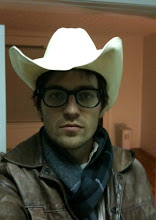
"Julia"
I've made a number of short films and videos as a kind of apprenticeship. I've heard a from the likes of Jim Jarmusch and Quentin Tarantino that their first movies were bad, and how they wouldn't want anyone to see them now. I figured that if their first movies were bad, then mine probably would be too, so I might as well just make them and get them out of the way.
I wrote dozens, maybe even hundreds, of pages of scripts in high school classes. My friend Chip and I wrote a Vietnam War movie featuring Prometheus, the man who stole fire from the Gods. I saw "The 400 Blows" and wrote a semi-autobiographical New Wave coming of age drama. I didn't have a good video camera or a computer, so I never really made a movie until I was 19 years old (save the improvised, unfinished "The Magic Baseball" which I've yet to upload to youtube). After I saw the movie "Adaptation" I got the book "Story" by Robert McKee. Later I read David Mamet's "On Directing Film" and "The 3 Uses of the Knife" and took screenwriting classes, and I feel these books shaped my writing in a very kind of sitcom-y style, which I have only recently figured out how to escape.
McKee recommends planning your story out on note cards before attempting to write your screenplay. Each scene gets a note card and you write the beats on it. I would argue that it is nearly impossible to write this way (at least for me). It's like asking a river to flow in reverse. It causes you to think too rationally. It introduces the critical impulse before the creative has had a chance to express itself. Joseph Campbell speaks of how Pegasus, or poetry, was born out of Medusa's severed head. One must remove the critical agent, the "head", before one's creativity can take off. How can one write if one is sitting around thinking of little bits of information to put on note cards? It is only after one dives into a situation, a scene, after one's hand is moving freely, writing, that the intricacies, the details, the life comes into a scene. You travel into the layers of a thing. If you sit around thinking, and not writing, you remain on the surface. I would advise a screenwriter to visualize everything, to see the movie in your head and write what is seen and not worry about three act structure or story beats or any of that. It is a natural human tendency to structure things dramatically. The most satisfying course a basketball game can take is to have one's home team suffer early on and have to make a comeback which climaxes with a three-pointer made "at the buzzer." A story, if you work at it hard enough, will find it's structure as water finds it's level. Part of the problem with movies today is that we have internalized the form as audience members so completely, and that writers obey it so slavishly, that it has become predictable. After the premise, the conflict has been set up by the end of the first act (ten to fifteen pages, or minutes, in), the movie rarely spirals out of it's own constructed ethos into the unpredictable. The hero is guaranteed to have a third act break were he or she loses everything, only to surge against the antagonist at the end and either acheive their goal or be denied. The writer should be following the story where it wants to take him, he shouldn't be forcing the story to take the course of some prefabricated structure or form. A movie should unfurl like a flower, rooted in one place, but free to grow wherever the sun leads it.
Writing is a voyage into the unknown, and if one has the guts to throw oneself off the cliff without note cards stories have a way of solving themselves. The seemingly invented, inconsequential details of the thing lead to the resolution. The way things are written now, every detail must add up to the sum of the film, must lead in some way to the climax. Movies are slim, efficient emotional machines calculated to evoke a particular emotional reaction from the viewer. Hollywood achieves this with great success every few years. Think of how you felt at the end of "The Usual Suspects." The machine of that film was so finely calibrated that it triggered the surprise, the thrill in all of us. Many Hollywood movies are aiming at this kind of reaction. This is not the only way to make a movie, however. Jimmy Stewart told a story of how, late in his career, a man came up to him on a film set somewhere in the country, Colorado or someplace, and asked him, "You Stewart?" He said Yeah. The guy said, "You read a poem in a movie once. That was good." The man didn't remember the story, the context, only the scene, the moment, but that is enough. Movies should be curious. The dance contest in "Pulp Fiction" has little to do with the plot, but it is a joyous, memorable sequence. Movies should be concerned with creating these kind of moments and images. Movies needn't be roller coasters where every rail and board, where every line of dialogue and shot is building, building, building towards the climax. They should be works of art encompassing the totality of man's existence, great and small. They should be paintings, poems, songs, novels, plays, operas all rolled into one. They should have a little fat on their bones.
The tough thing about movies is expressing things only through pictures and dialogue. Too many people think writing dialogue is writing movies. It isn't. It's writing radio plays. It's writing sitcoms. People end up writing 12 characters that all speak in the same "witty", "urbane" voice. It's verbal ping pong. This is why so many sitcoms have cute eight year old girls who talk like middle aged comedy writers. Writers are crafting situations and peopling them with faceless vessels for their own jokes. It isn't even just sitcoms. Aaron Sorkin is an example of a well-respected writer who's characters are essentially mouthpieces for one voice. The characters parry and joust, swipe at each other as they walk down hallways. The walks give the illusion of movement, of action, but nothing is really happening. In order to escape this, a writer must not create from a place where two characters are speaking to each other in the darkness. He must instead imagine in vibrant life the totality of a situation, as if he were writing a novel and record that. Nabokov said something about how he never thinks in words, he thinks in images. He just uses words to communicate the images to others. This is what a screenwriter must do, communicate the image to the director, actors, the artisans on the set.
Advice from one who has read McKee, Mamet, taken screenwriting classes: Don't read these books. Don't read any books. The only way to learn how to make movies is to make movies. Solve the problems on a one to one basis. Do not try to follow any rules. Every film has a number of difficulties that will arise, and you must face each of these as they come. They are what making a film is about. If you don't like arguing with an actor over a line reading, if you don't like filming outside in freezing temperatures, if you don't like waiting around while they set up lights for 3 hours, don't make films. Go do something easy, something predictable, like work in an office.
Mamet says that there is no such thing as character, only action, lines on a page, but this is a very dangerous thing for a writer or filmmaker to hear. Of course, plays and movies, the dramatic arts, are about action, but if one writes or acts believing "There is no such thing as character," one will have a tough time creating anything specific or original. People, characters handle situations differently. An elephant walks differently from a mouse. Zorro would handle the kidnapping of his daughter differently than Uncle Buck might. The characters must be specific, unique. If Hamlet were nothing but a plot line, a neutral, blank entity's desire and obstacles, there would be nothing of interest in it. Hamlet is what makes Hamlet intersting. Just because a character has a "goal", an "objective" doesn't mean we're going to care if he or she achieves it. The objective is only interesting insofar as we can relate to it, as we can sympathize or respect the character who is after it. We wouldn't care one way or the other if John McClane saved those imaginary people in Nakatomi Tower if he were just some regular guy, but John McClane is funny and badass and that's why we want to see Hans Gruber eat it. John McClane is an interesting character and a good guy and this is why we want him to be able to make it home for Christmas. If John McClane had no individuality, if he weren't a smartass, if he weren't a character, we wouldn't give two shits if he lived or died. "The Big Lebowski" is a movie where, essentially, the plot is laughable, yet it is endlessly watchable due to the hilarious eccentricities of the characters.
One of the things that is frustrating about making films is that, the way things are done nowadays, you have to make a film three times. Once, when you imagine and write it, again when you shoot it, and finally when you edit it. A fully realized and carefully planned screenplay is like a grocery list. You set out for the store to gather specific ingredients which later you will put into the pot and stir and cook into a film. The mechanization of the process, the equipment that Hollywood has taught us is "required": trucks full of lights, set pieces, costumes etc. bring the creative process to a crawl, and allow little room for interference or the spirit of invention. Any kind of unpredictability on a set leads to problems. Orson Welles said a director is one who "presides over accidents." Francis Ford Coppola said a director is "Ringmaster of a circus that is inventing itself." And yet most films try to fortify themselves against the unpredictable, against accident, the unforseen. If it rains, if a certain prop or costume can't be obtained, the whole scene could be ruined. I would much rather make a film with vague notions, where the story arises during the process like an island from a mist. I would rather start out with a treatment, an outline, improvise the shooting, and craft the story in the editing, and this is what I'm doing with the film I'm making right now, a story about a Greek gypsy living in New York. It's also sort of what I did with my short "Julia" (seen above), which is on Youtube, a video I did for my Gothic literature class, and probably the best thing I've yet done.
Anyway, you can check out my shorts here. They're pretty mediocre overall, but there are some fairly beautiful images here and there. I am fine with this, because I've figured out how to work, and I will make better films in the future.
Showing posts with label writing. Show all posts
Showing posts with label writing. Show all posts
27 April 2009

06 February 2009
Two quotes and a poem by Rimbaud
These are absolutely true to me.
"The two hardest things about writing are starting and not stopping."
-Stuart somebody
"A writer takes earnest measures to secure his solitude and finds endless ways to squander it."
-Don Delillo
Novel
I.
No one's serious at seventeen.
--On beautiful nights when beer and lemonade
And loud, blinding cafés are the last thing you need
--You stroll beneath green lindens on the promenade.
Lindens smell fine on fine June nights!
Sometimes the air is so sweet that you close your eyes;
The wind brings sounds--the town is near--
And carries scents of vineyards and beer. . .
II.
--Over there, framed by a branch
You can see a little patch of dark blue
Stung by a sinister star that fades
With faint quiverings, so small and white. . .
June nights! Seventeen!--Drink it in.
Sap is champagne, it goes to your head. . .
The mind wanders, you feel a kiss
On your lips, quivering like a living thing. . .
III.
The wild heart Crusoes through a thousand novels
--And when a young girl walks alluringly
Through a streetlamp's pale light, beneath the ominous shadow
Of her father's starched collar. . .
Because as she passes by, boot heels tapping,
She turns on a dime, eyes wide,
Finding you too sweet to resist. . .
--And cavatinas die on your lips.
IV.
You're in love. Off the market till August.
You're in love.--Your sonnets make Her laugh.
Your friends are gone, you're bad news.
--Then, one night, your beloved, writes. . .!
That night. . .you return to the blinding cafés;
You order beer or lemonade. . .
--No one's serious at seventeen
When lindens line the promenade.
I misunderstood this poem. I thought it was about being 17 and getting drunk and trying to get laid. I guess it's about the way I should be living my life rather than the way I actually am.
"The two hardest things about writing are starting and not stopping."
-Stuart somebody
"A writer takes earnest measures to secure his solitude and finds endless ways to squander it."
-Don Delillo
Novel
I.
No one's serious at seventeen.
--On beautiful nights when beer and lemonade
And loud, blinding cafés are the last thing you need
--You stroll beneath green lindens on the promenade.
Lindens smell fine on fine June nights!
Sometimes the air is so sweet that you close your eyes;
The wind brings sounds--the town is near--
And carries scents of vineyards and beer. . .
II.
--Over there, framed by a branch
You can see a little patch of dark blue
Stung by a sinister star that fades
With faint quiverings, so small and white. . .
June nights! Seventeen!--Drink it in.
Sap is champagne, it goes to your head. . .
The mind wanders, you feel a kiss
On your lips, quivering like a living thing. . .
III.
The wild heart Crusoes through a thousand novels
--And when a young girl walks alluringly
Through a streetlamp's pale light, beneath the ominous shadow
Of her father's starched collar. . .
Because as she passes by, boot heels tapping,
She turns on a dime, eyes wide,
Finding you too sweet to resist. . .
--And cavatinas die on your lips.
IV.
You're in love. Off the market till August.
You're in love.--Your sonnets make Her laugh.
Your friends are gone, you're bad news.
--Then, one night, your beloved, writes. . .!
That night. . .you return to the blinding cafés;
You order beer or lemonade. . .
--No one's serious at seventeen
When lindens line the promenade.
I misunderstood this poem. I thought it was about being 17 and getting drunk and trying to get laid. I guess it's about the way I should be living my life rather than the way I actually am.
15 July 2008
The Soft
We're all so goddamned special aren't we? Everyone I know is an artist, a musician, a philosopher, a writer, an actor, a director, a dancer, and sometimes all of these things at once. Myself included. I'm probably the worst offender of all. It'd be a real shame if we didn't share our unique and profound minds with the world, if we didn't "express ourselves" (probably one of the most vile phrases in the language). I'm not sure, but I suspect that real art isn't about self-expression at all and that self-expression is basically a form of masturbation.
And what will happen to us? Some will be ground up and packaged and earn a lot of money making advertisements. Some will live in once-grand Victorian mansions furnished with soggy old couches and grimacing bookshelves, blocks from the colleges where we teach. Others will vomit up our creativity in the morning with last night's beer and go wait tables. Some will frequent coffee houses and grow so fat in the head with smarm and knowledge that we will barely fit through the holes of our turtlenecks. A handful of us might actually have something brilliant and original to say, and will be completely miserable for it.
I don't know if I could live any other way.
And what will happen to us? Some will be ground up and packaged and earn a lot of money making advertisements. Some will live in once-grand Victorian mansions furnished with soggy old couches and grimacing bookshelves, blocks from the colleges where we teach. Others will vomit up our creativity in the morning with last night's beer and go wait tables. Some will frequent coffee houses and grow so fat in the head with smarm and knowledge that we will barely fit through the holes of our turtlenecks. A handful of us might actually have something brilliant and original to say, and will be completely miserable for it.
I don't know if I could live any other way.
Subscribe to:
Posts (Atom)